Nếu đây là lần đầu tiên đến với Điện Tử Việt Nam, bạn có thể đọc phần Hỏi đáp bằng cách nhấn vào liên kết. Có thể bạn cần đăng kí trước khi có thể gửi bài . Để bắt đầu xem bài viết, chọn diễn đàn bạn muốn thăm dưới đây.
cái đó có tên là dao động j nhỉ? cái tran như thế lại có dòng chảy từ E->C ah? lần đầu tiên mình biết mạch này. 1 tran ko cần cuộn hồi tiếp. rất hay các bạn ah.
"điều quan trọng khi lập nghiệp ko phải ở thành phố hay ở quê, mà quan trọng là chúng ta nhận định ra hướng đi nào là đúng"
yahoo:
gmail:
e tìm thấy tài liệu về mạch này rồi. bác nào giỏi tiếng anh dịch cho a e trên diễn đàn rõ với
nguyên văn của nó đây:
"UNCONVENTIONAL CIRCUITS:
The following circuit converts 1.5v to a voltage that is higher than the reverse break-down voltage of the emitter-collector junction of the BC547. When this voltage is reached the junction breaks-down and creates a low voltage across it. This allows the voltage on the 100u to pass to the white LED and create a flash. The voltage across the 100u drops and the junction comes out of conduction and the cycle repeats.
The next circuit uses the same "Junction Breakdown" phenomenon but this time the high voltage is supplied by a 12v to 20v battery.
All transistors have a single junction or two junctions between each pair of leads. They are called a "PN" junction or a PNP junction or an NPN junction - depending on which leads are selected. The junctions between each pair of leads behave differently, however the junction(s) we are interested in, is between the collector and emitter leads.
When a voltage is applied to these leads in the reverse direction, an unusual thing happens.
As the voltage is increased, the junction suddenly breaks down and a high current will flow , according to the energy available from the electrolytic. This occurs at a voltage of between 12v and 20v, (some transistors will require a higher voltage) depending on the type of transistor and the manufacturer. When the voltage across the leads falls, the current stops.
In other words, the resistance between the two leads decreases when the voltage rises to between 12v and 20v (and the voltage across the two leads is about 0.5v and this is a characteristic of the junction). When the supply-voltage drops, the junction-resistance increases and the electrolytic charges.
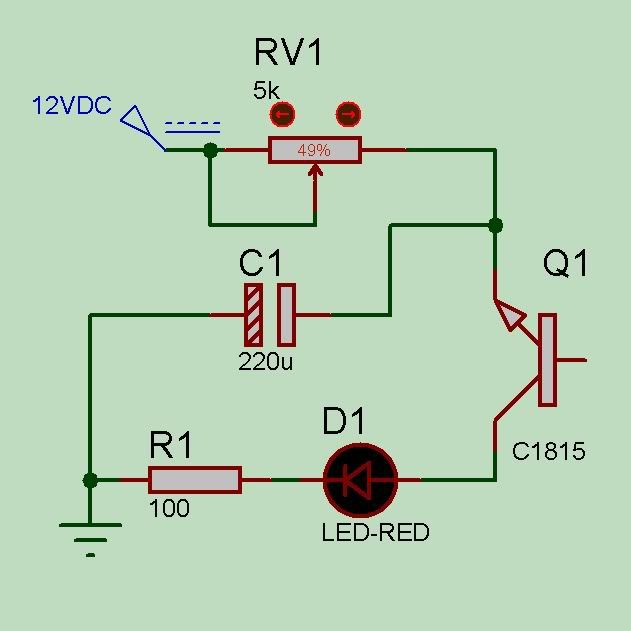
This feature can be used to flash a LED as shown in the following diagram:
Flasher circuit using "Junction Breakdown"
The circuit above is very unreliable and only works with some transistors. The voltage is very important. It must be high enough to cause the junction(s) between the emitter and collector leads to breakdown.
The flash-rate will depend on the value of the top resistor and the electrolytic and also the voltage at which the transistor break-down. The circuit consumes less than 1mA and the 100R prevents a high current flowing through the LED (from the electrolytic). Without the 100R, the LED is destroyed instantly.
The circuit is a very good demonstration of breakdown but due to the high supply voltage needed, it is not a practical design. The previous circuit should be used."
trưa trưa đi học về dịch tầm bậy tầm bạ cho, mạch này mình nghĩ nó hoạt động theo kiểu đặc tính tự khuyếch đại dòng rò cuả trans, còn việc dẫn từ E--->C là bình thường
Chào mọi người, động cơ bước có hộp số (https://www.oyostepper.es/category-2...eductores.html) trên thiết bị của tôi đã được sử dụng khoảng sáu tháng. Gần đây, tôi nhận thấy dầu rò rỉ từ trục đầu ra. Mỡ bôi trơn đã bị chảy và nhỏ giọt...
Tôi muốn nâng cấp thiết bị của mình để tăng tốc độ, vì vậy tôi đã thay đổi nguồn cấp cho mạch điều khiển từ 24V lên 48V. Động cơ vẫn giữ nguyên và dòng điện định...
Bạn cần sơ đồ mạch ổn áp bao nhiêu Volt, Nếu giống anh bạn guiwr có khả năng ổn áp dùng iC họ 78XX, 79XX. Những mạch này bạn tim kiếm trên google sẽ thấy!!
2. Các yếu tố để dòng điện đầu ra không bị "thiếu" Dòng điện đầu ra bị "thiếu" có thể hiểu là không đủ 10A theo yêu cầu hoặc bị sụt áp khi tải thay đổi. Để đảm bảo điều này, bạn cần xem xét các yếu tố sau: a. Khả năng chịu dòng của cuộn cảm
1. Tính toán cuộn cảm (Inductor) Để tính giá trị cuộn cảm, chúng ta cần thực hiện các bước sau: a. Xác định chu kỳ nhiệm vụ (Duty Cycle - D) Với mạch tăng áp lý tưởng, chu kỳ nhiệm vụ được tính theo công thức : D=1-VinVout=1-24V30V=0.2 Vậy D = 0.2 (20%) b....
Comment